
A future with zero deaths and serious injuries on our roads
Vision Zero is a globally recognized road safety approach that began in Sweden in 1997. It is founded on a simple but powerful belief: no one should be killed or seriously injured while travelling on our roads.
Grounded in the Safe System approach, Vision Zero recognizes that people will make mistakes but those mistakes should not result in death or life-altering injury. By designing safer roads, vehicles, speeds and policies – and by sharing responsibility among governments, transportation professionals, law enforcement and road users – we can create a transportation system that is safe for everyone.
Vision Zero’s goal is to eliminate traffic-related deaths and serious injuries while ensuring safe, healthy and equitable mobility for all.
Parachute’s national leadership in Vision Zero
Parachute is Canada’s national leader in advancing Vision Zero by bringing together municipalities, organizations, practitioners and advocates to share knowledge, strengthen collaboration and accelerate action toward safer roads. Through national leadership, evidence-informed resources and a growing network of partners, Parachute supports communities of all sizes in implementing Vision Zero and the Safe System Approach.
Follow and join the conversation using #ParachuteVZ on social media to stay informed and support safer communities across Canada.
Parachute Vision Zero works to:
- Develop and share evidence-informed Vision Zero resources, tools and best practices to support road safety efforts across Canada.
- Support urban and rural jurisdictions in understanding, adopting and advancing Vision Zero and the Safe System Approach.
- Connect road safety professionals, decision-makers and community partners to foster collaboration, knowledge exchange and collective action.
- Promote data-informed approaches to help communities identify priorities, measure progress and improve road safety outcomes.
Why Canada needs Vision Zero
Every year, thousands of Canadians are killed or seriously injured on our roads. These tragedies are preventable, yet road trauma remains a significant public health issue with devastating human, social and economic impacts.
In 2023, motor vehicle collisions resulted in:
- 1,964 Canadians killed on our roads – the highest number of road fatalities in the past decade.
- 9,261 Canadians seriously injured – the highest number in the past five years.
- 298 pedestrians and 47 cyclists killed, highlighting the risk faced by vulnerable road users.
The estimated social cost of transport injuries in Canada is $3.6 billion annually.
Leading contributors to fatal collisions
Road deaths and serious injuries are not caused by a single factor. They result from the interaction of human behaviour, road design, vehicle safety and the broader transportation system.
According to Transport Canada’s National Collision Database, in 2023:
- Speeding or driving too fast was a contributing factor in nearly 25 per cent of fatal collisions.
- Distraction was a contributing factor in 18 per cent of fatal collisions.
- Impaired driving was a contributing factor in 22 per cent of fatal collisions.
Vision Zero: A proven approach
Since introducing Vision Zero in 1997, Sweden has demonstrated that road deaths and serious injuries can be significantly reduced through safer road design, speed management, safer vehicles and a Safe System Approach. Results include:
- Traffic deaths per 100,000 people decreased by 68 per cent between 2000 and 2019.
- Road deaths among children under age seven declined from 58 in 1970 to just one in 2012.
Vision Zero is also delivering results in Canada. Edmonton, the first Canadian city to adopt Vision Zero in 2015, reported:
- 50-per-cent reduction in traffic-related fatalities between 2015 and 2022.
- 32-per-cent reduction in serious injuries during the same period.
Today, Vision Zero is recognized internationally as a leading framework for preventing road deaths and serious injuries. The World Health Organization (WHO) identifies the Safe System Approach that underpins Vision Zero as a global best practice for improving road safety.
The Vision Zero difference
Traditional approaches often focus on changing individual behaviour after crashes occur. Vision Zero takes a different approach by improving the entire transportation system to reduce the likelihood and severity of crashes.
Grounded in the Safe System Approach, Vision Zero recognizes that responsibility for road safety is shared.
Designs safer systems
Transportation planners, engineers and system designers create safer roads and infrastructure and redesign them when they do not adequately protect people.
Builds safety into policies and decisions
Governments and policymakers demonstrate leadership by making road safety a priority across transportation, land-use planning and public policy.
Supports effective enforcement
Law enforcement agencies help create safer roads through fair and equitable enforcement of laws related to speed management, impaired driving and distracted driving.
Encourages safer road use
Road users have a responsibility to follow traffic laws and make choices that contribute to safer communities.
The Vision Zero commitment
Components of a strong commitment
- Action plan
- Co-operation and collaboration
- Community engagement
- Data-driven
- Equity
- Multi-disciplinary leadership
- Political commitment
- Systems-based approach
- Transparency
Key activities
- Advocacy for policy change
- Enhanced regulation and enforcement
- Raising public awareness and commitment to road safety
- Road infrastructure changes
Focus areas
- Continued leadership, collaboration and accountability among all stakeholders
- Enhancing the safety of vulnerable road users
- Leveraging innovative technology (red light cameras, automated speed enforcement)
- Improving road infrastructure for all road users
- Increasing enforcement of laws to manage safe speeds and reduce impaired and distracted driving
- Positioning road safety as a top priority in policy-making
- Strict vehicle regulation and testing
Resources
2026 #SnapForChange Vision Zero campaign
These videos draw on findings from a 2026 road safety survey conducted by Parachute’s road safety partner, Desjardins Insurance. They address the importance of road design, speed management, and protective infrastructure for pedestrians and cyclists as key components Canadians support to create safer roads.
2024-25 Hugo Houle Vision Zero campaign
Canadian professional cyclist Hugo Houle generously donated his time to create these videos to promote road safety and Vision Zero. Houle's younger brother died while cycling after being struck by a vehicle driver.
2023 Vision Zero short videos
These short animations were created by Premise Communications to promote public awareness and support of Vision Zero road safety principles and actions.
2022 #ShareSafeRoads campaign videos
Parachute has launched a national awareness campaign based on Vision Zero principles that calls on Canadians to #ShareSafeRoads: we need to accommodate all road users and build safe road systems for them to use. Videos created by Mass Minority.
2021 Vision Zero campaign videos
These short animated videos, produced in 2021 by Parachute, highlight key findings from our 2021 Road Safety Survey under the theme #EndDeathsOnOurRoads. These videos were part of our Vision Zero campaign outreach from 2021 to 2023, which won Silver in the best campaign category at the 2024 International Safety Media Awards.
-
Drivers, not cellphones, biggest cause of pedestrian injury
More people surveyed (65 per cent) identified pedestrians walking while talking on a cell phone as an increased danger on our roads than any other dangerous activity and 79 per cent chose texting and crossing the street as the no. 1 danger to pedestrians. However, Transport Canada analysis shows that drivers who are distracted, speed and fail to yield are the biggest danger to pedestrians.
3.05 MB Video
-
Roundabouts reduce crash deaths by 65%
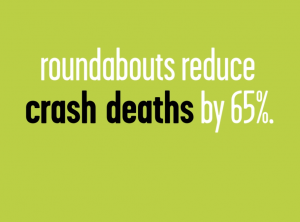
In the Ipsos National Road Safety Survey, only half of those surveyed thought roundabouts were an effective safety measure to reduce road deaths. However, a meta-analysis of the effects of roundabouts showed they reduce crash deaths by 65 per cent.
2.05 MB Video
-
Speed is a factor in one-quarter of road deaths

Our Ipsos National Road Safety Survey found that only 22 per cent of respondents agreed that speed limits should be lowered to make roads safer, and that half of the drivers surveyed had been fined for speeding. However, research published in 2018 from the Traffic Injury Research Foundation shows that one quarter of drivers were speeding at the time of a fatal crash.
2.59 MB Video
-
We can change our roads to make them safe for cyclists
Our survey found that only one in five Canadians say roads are safe for cyclists, compared to three in five who say roads are safe for drivers. However, roads constructed with separated bike lanes and other adjustments to traffic flow, such as no right turn on red lights, greatly reduces the number of collisions between drivers and cyclists.
2.89 MB Video
-
You are scaring your passengers when you speed
Parachute’s 2021 road safety survey found that the majority of Canadians, when a passenger in a car, say they’ve felt unsafe because of speed; however, three quarters of all drivers admitted to exceeding a highway speed limit at least once in the previous year.
2.70 MB Video
-
You are six times more likely to kill a pedestrian if you hit them driving 50 km/h than at 30 km/h

You are six times more likely to kill a pedestrian if you hit them driving 50 km/h than at 30 km/h
Less than half of Canadian residents saw reduced speed limits as an effective road safety strategy in our Ipsos National Road Safety Survey; yet a systematic review of impact speed showed pedestrians struck by a driver travelling 50 km/h is nearly six times more likely to die than a person struck by a driver travelling 30 km/h.2.37 MB Video
Introducing your community to Vision Zero
-
Committing to Vision Zero – A Primer
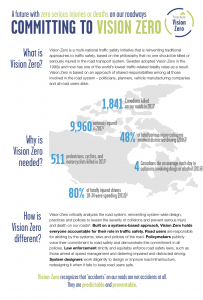
Download this one-pager for information on what Vision Zero is, what a Vision Zero commitment entails, and how to make it a reality in your community.
249.35 KB PDF/UA
Media
-
Link
This panel of guests have plenty to say about Doug Ford’s speed camera plan
The Closer Look Podcast — September 29, 2025
-
Link
I got a $93 speed camera ticket for going 14 km/h over the limit. How did they come up with that fine?
Globe and Mail — September 28, 2025
-
Link
Should Waterloo Region ban right turns on red?
CBC News — August 12, 2025
-
Link
Do curb extensions at crosswalks make intersections safer?
-
Link
The fight against photo radar: does it make streets safer?
-
Link
Am I driving too fast? The community safety zone episode
Your Region Pod — October 24, 2024
-
Link
‘We know how to do this better’: How Vernon pedestrians could be safer
iNFOnews.ca — September 1, 2024
-
Link
Does photo radar actually make roads safer or is it the ‘cash grab’ Alberta says?
-
Link
Would banning right turns on red lights make intersections safer?
-
Link
Is tech that’s meant to reduce driver distraction still too distracting?
-
Link
Cities look to copy Montreal’s ban of right turns on red, but safety data lacking
CTV News — November 12, 2023
-
Link
Walk and talk highlights challenges of getting around in Guelph neighbourhood
-
Link
Walkshop looks at pedestrian safety in Guelph neighbourhood
-
Link
Child Active-Transportation Safety and the Environment
Transportation Talk — May 1, 2023
-
Link
Canadians want safer roads
iHeart Radio Windsor — March 29, 2023
-
News release
More than half of Canadians say that road safety should be among the top five priorities for government to address in their community
-
Link
Right Of Way
Maisonneuve: A quarterly of art, opinion and ideas — December 17, 2022
-
Link
Injury collisions declining in Calgary, but distracted driving still a concern – Calgary Herald
calgaryherald.com — October 26, 2022
-
Link
Valerie Smith talks about the “Vision Zero” approach to safe roads
-
Link
Parachute President and CEO Pamela Fuselli talks to CP24 about how people can work to prevent fatal crashes.
www.cp24.com — April 5, 2022
-
Link
Desjardins invests $3.2M to help keep Canadians safe on the road
www.desjardins.com — March 23, 2022
-
Link
Safety group calling for limit on how fast cars can travel as road deaths rise
CTV News Toronto — December 31, 2021
-
Link
The limit’s 100 km/h. So why should any new car let you go twice that?
Toronto Star — December 29, 2021
-
Link
Most Canadians don’t support reducing speed limits, even if it would improve road safety: survey
www.insauga.com — May 28, 2021
-
News release
Nearly all Canadians want safer roads, but fewer are willing to embrace proven measures to make that happen
-
Link
Road traffic injury during the #COVID19 pandemic: Cured or a continued threat?
University of Toronto Journal of Public Health — January 4, 2021
-
Link
The other side of the pandemic: fewer traffic deaths
Ottawa Citizen — October 30, 2020
-
News release
Learn how Canadian jurisdictions can make their Vision Zero commitment
-
Link
CEO Pamela Fuselli interviewed at the 3rd Global Ministerial Conference on Road Safety in Stockholm
-
Link
Comment rendre les intersections plus sécuritaires pour les piétons? (How to make the intersections safer for pedestrians?)
Radio-Canada — January 24, 2020
-
Link
Interim CEO Pamela Fuselli on Vision Zero: Would it work in Ottawa?
-
Link
Interim CEO, Pamela Fuselli, about Vision Zero on Breakfast Television Calgary
Breakfast Television & Citytv Calgary — May 30, 2019
-
Link
CEO Steve Podborski interviewed on Vision Zero
Canadian International Autoshow — February 16, 2019